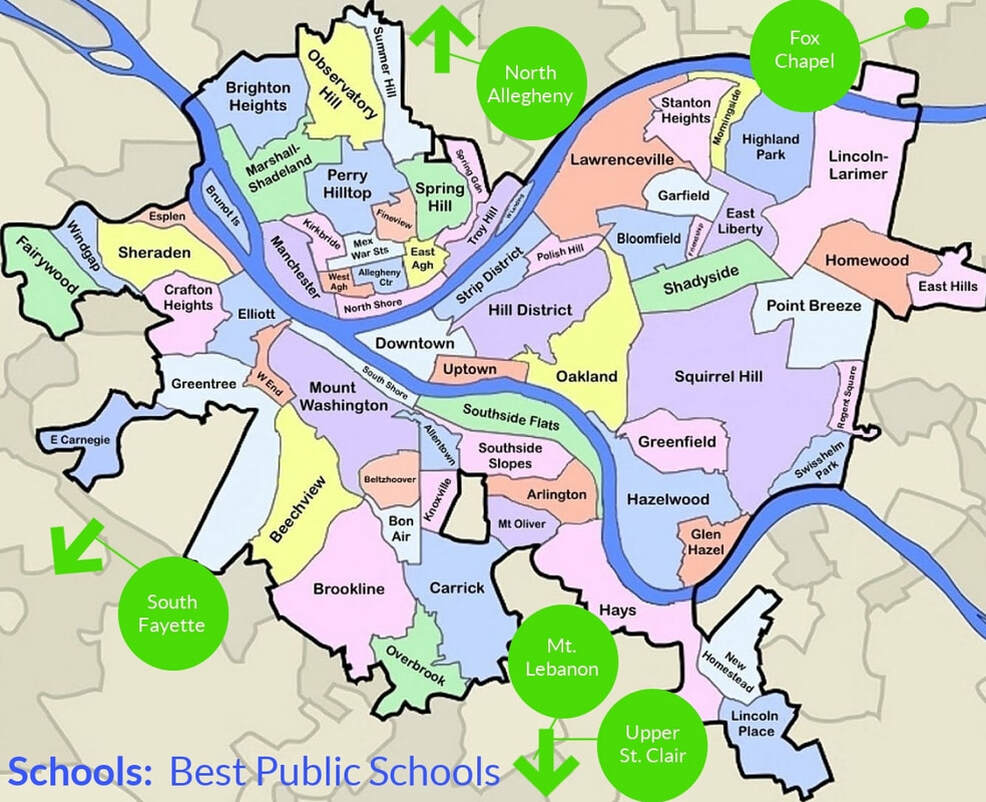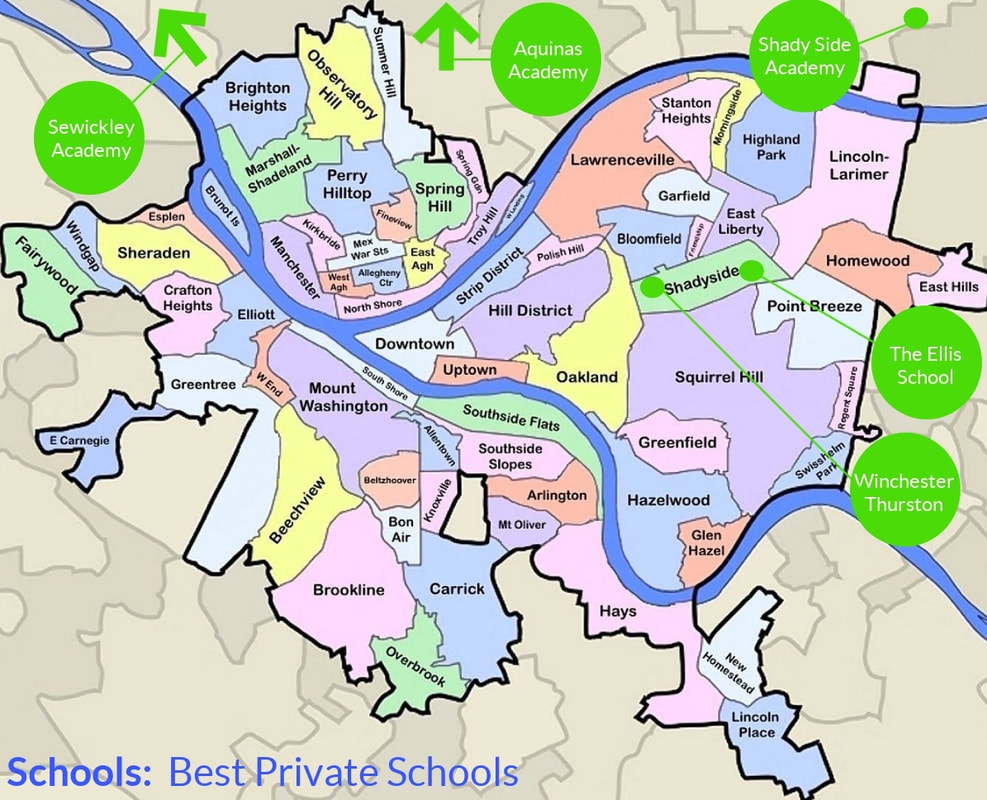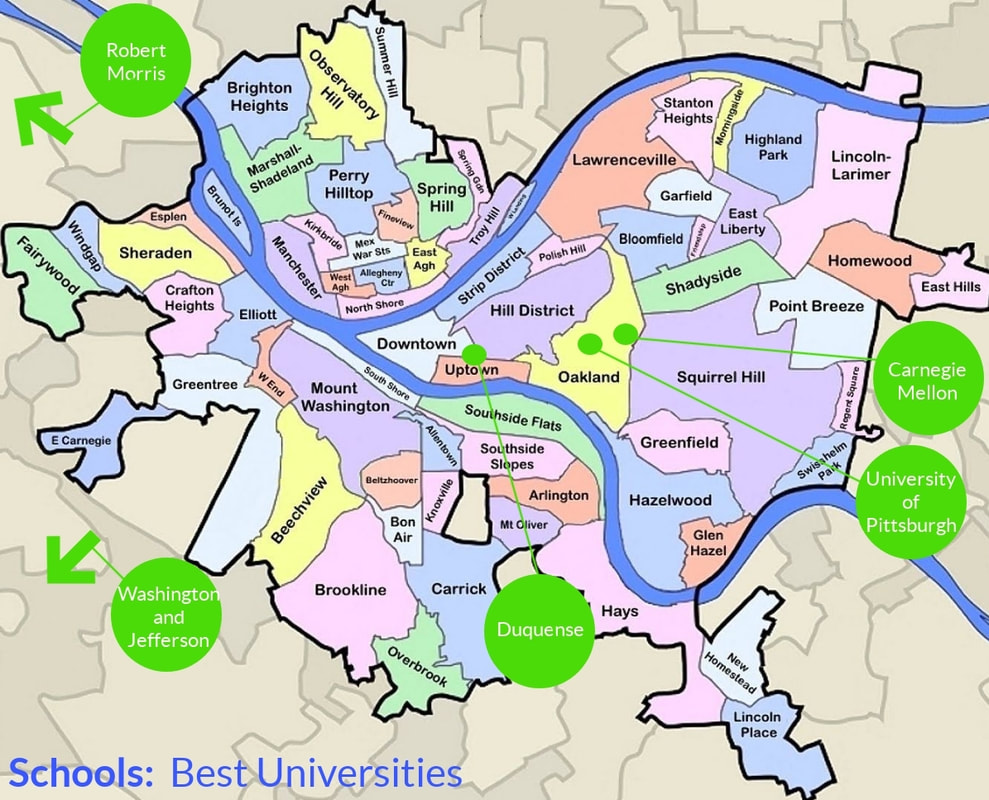
In Pennsylvania, your assigned public school district and neighborhood school usually depend on your exact home address.
Pittsburgh Schools Explained: Public, Private, Magnet, Charter & College Options
A plain-English guide for families, students, homebuyers, renters, and people relocating to Pittsburgh.
This guide is for general education and relocation planning only. School boundaries, admissions rules, deadlines, rankings, tuition, transportation, and eligibility rules can change. Verify details directly with the school, district, or official source.
The short version
City residents are generally served by Pittsburgh Public Schools, which offers neighborhood schools, magnet options, career and technical education, and other programs.
Allegheny County includes many suburban school districts outside the City of Pittsburgh, so two homes with similar mailing addresses can have very different school assignments.
PPS magnet programs are not simply assigned by neighborhood. Families must apply, and some programs use lottery, audition, or other criteria.
Private, independent, Catholic, and religious schools have their own admissions, tuition, calendars, and transportation policies.
School fit should include programs, commute, culture, student needs, special services, extracurriculars, and your child’s learning style — not just a score.
The main education options in Pittsburgh
Pittsburgh has many education options, but the system can feel confusing at first. This overview explains the choices in plain English—what each path is, who it may fit, and what to verify with official sources.
Neighborhood public schools
Assigned public schools based on your home address within a district. Usually the default path unless you apply elsewhere.
Verify: exact address, district boundary, assigned elementary/middle/high schools, enrollment documents, transportation.
Pittsburgh magnet schools
Choice-based programs within Pittsburgh Public Schools focused on arts, STEM, languages, Montessori models, and career themes.
Verify: application deadlines, lottery or audition rules, eligibility, transportation, waitlists.
Charter and cyber charter schools
Public schools with their own application processes—not the same as your assigned neighborhood school.
Verify: application timeline, special education supports, commute, accountability data, enrollment rules.
Suburban public school districts
Separate districts across Allegheny County outside the City of Pittsburgh, each with its own boundaries and enrollment office.
Verify: municipality, district name, assigned schools, open enrollment or special programs if any.
Private and independent schools
Nonpublic schools with their own admissions, tuition, calendars, and program philosophies.
Verify: grade levels, deadlines, financial aid, accreditation, learning supports, transportation.
Catholic and religious schools
Faith-based or religiously affiliated schools with separate admissions and often parish or diocesan connections.
Verify: affiliation, tuition assistance, religious requirements, grade span, transportation.
Homeschooling
Home education programs allowed in Pennsylvania when state and district filing requirements are met.
Verify: current PDE home education rules, district affidavit deadlines, evaluations and testing requirements.
Career and technical education
Hands-on high school pathways for credentials, technical skills, and career-connected learning.
Verify: program availability, eligibility, application timing, transportation, industry certifications.
Colleges, universities, and adult education
Higher education and technical training across the Pittsburgh region for older students and relocating adults.
Verify: program requirements, accreditation, housing, commute, financial aid, transfer credits.
Start with the address — it usually determines the public school path
For most families, the first step is identifying the school district tied to the exact property address. In the City of Pittsburgh, families can use Pittsburgh Public Schools’ School Search tool to identify assigned schools. Outside the city, the home may be in a suburban district even if the mailing address says “Pittsburgh.”
Important: Do not rely only on a real estate listing, ZIP code, or neighborhood name. Verify the school district and assigned school using official district tools before signing a lease or buying a home.
- Confirm municipality
- Confirm school district
- Confirm elementary, middle, and high school assignment
- Confirm transportation
- Confirm enrollment documents
- Confirm special program eligibility
City public schools: Pittsburgh Public Schools
Pittsburgh Public Schools serves students in PreK through grade 12 and is the public school district for the City of Pittsburgh. PPS offers neighborhood schools, magnet schools and programs, early childhood programs, career and technical education, and other pathways.
Neighborhood schools
Every student is assigned to a neighborhood school based on address. Neighborhood school does not always mean “the closest building,” so families should use the official search tool.
Enrollment
Families new to PPS should review the enrollment process and required documents through PPS. Families who want to apply to magnet programs generally first need to enroll in their designated neighborhood school, then apply through the magnet process.
Magnet schools: choice-based programs inside Pittsburgh Public Schools
Magnet schools and programs allow students to pursue specific interests, talents, or academic and career goals. They are not neighborhood-specific, so PPS students from across the district may be eligible to apply.
Magnet programs require an application. Placement may involve a lottery, post-lottery registration, preferences, eligibility criteria, or audition for programs such as Pittsburgh CAPA.
Deadlines change each school year. Families relocating to Pittsburgh should check current PPS magnet deadlines as early as possible.
Examples of magnet focus areas (not a complete list):
- Arts and creative programs
- Science, technology, engineering, and math
- International or language-focused programs
- Montessori or specialized learning models
- Career-focused pathways
Admission is not guaranteed. Review current rules on the official magnet pages before planning a move around a specific program.
Charter and cyber charter schools
Charter schools are public schools that operate under a charter and usually have their own application process. Pittsburgh Public Schools monitors City of Pittsburgh charter schools for performance and compliance with charter agreements. Cyber charter schools are handled differently; families should verify details with the Pennsylvania Department of Education and the individual school.
- They are public schools, but not the same as assigned neighborhood schools.
- Each school may have its own application timeline.
- Transportation, services, and enrollment rules should be verified directly.
- Compare academics, services, stability, commute, culture, and special education supports—not just marketing materials.
Suburban districts: a different school system outside the city
Allegheny County has many suburban public school districts outside the City of Pittsburgh. The Allegheny Intermediate Unit supports 42 suburban school districts, along with non-public, charter, and vocational-technical schools.
Families often compare city and suburban districts based on academics, commute, budget, housing style, and lifestyle—not because any one region is objectively “best” for everyone.
Mailing address warning: A home can have a Pittsburgh mailing address but still be outside Pittsburgh Public Schools. Always verify the school district for the exact address.
Private and nonpublic schools
Pittsburgh has a wide range of private, independent, Catholic, religious, Montessori, and specialized schools. Unlike assigned public schools, these schools generally have their own admissions process, tuition, calendars, financial aid, transportation policies, and program offerings.
Examples only—not a complete or ranked list: Shady Side Academy, Winchester Thurston, The Ellis School, Falk Laboratory School, Central Catholic, Oakland Catholic, Sewickley Academy, and others.
What to check
- Grade levels served
- Admissions deadlines
- Tuition and financial aid
- Transportation options
- Religious affiliation or educational philosophy
- Accreditation or licensing status
- Special education and learning support
- Before/after care
- Athletics, arts, and extracurriculars
Homeschooling in Pennsylvania
Pennsylvania allows home education programs when legal requirements are met. The Pennsylvania Department of Education describes requirements including a supervisor filing a notarized affidavit or unsworn declaration to the superintendent of the school district of residence before beginning and annually by August 1, plus evaluation and testing requirements in certain grades.
Not legal advice. Homeschool rules are specific and can change. Families should review the Pennsylvania Department of Education’s current home education guidance and contact their district of residence if needed.
Career and technical education
Career and technical education can be an important pathway for students who want hands-on training, industry-recognized credentials, technical skills, or a career-connected high school experience.
Pittsburgh Public Schools offers CTE options, and Pennsylvania has career and technical education centers across the state offering PDE-approved programs.
Examples of focus areas (not a complete list):
- Health careers
- Engineering and technology
- Culinary arts
- Automotive and skilled trades
- Business and entrepreneurship
- Cosmetology
- Information technology
- Public safety
- Construction or carpentry
Eligibility, program availability, application timing, and transportation vary. Check directly with PPS, the suburban district, or the relevant career and technical center.
Colleges and universities
Pittsburgh is also a major higher-education city, with universities, colleges, community colleges, medical education, graduate programs, and technical training options. This matters for families with older students, relocating academics, medical professionals, visiting professors, fellows, residents, and graduate students.
Examples only—not a ranked list: University of Pittsburgh, Carnegie Mellon University, Duquesne University, Chatham University, Carlow University, Point Park University, Community College of Allegheny County, Robert Morris University, La Roche University, and other regional colleges and technical schools.
The Pittsburgh Promise
The Pittsburgh Promise can be an important scholarship consideration for families with children in Pittsburgh Public Schools. The Promise states that eligible students in certain graduating classes may receive up to $5,000 per year, up to $20,000 maximum, subject to requirements and program rules.
Eligibility varies. Not every PPS student qualifies. Verify GPA, attendance, residency, enrollment, graduation year, and other requirements directly with The Pittsburgh Promise.
How to research schools without relying only on rankings
Third-party school rankings can be useful starting points, but they should not be the only factor. A school with a lower overall score may still be a good fit for a particular student, and a highly ranked school may not be ideal for every child.
- Assigned school or district by exact address
- Student growth, not just test scores
- Course offerings
- Special education, IEP, 504, gifted, ESL, and learning supports
- Class size and school culture
- Transportation and commute
- Before/after care
- Safety and discipline climate
- Arts, athletics, clubs, and extracurriculars
- College and career readiness
- Parent communication
- School visit or open house impressions
- Fit for your child’s learning style
This page does not publish live rankings or “best school” lists. Use official and third-party tools below, then confirm details with schools and districts.
Which school path should you research first?
Answer a few questions for a practical next-step checklist. All guide content remains on this page if JavaScript is unavailable.
Your suggested next steps
City vs suburb school planning
← Scroll horizontally on small screens →
| Topic | City of Pittsburgh | Suburban districts |
|---|---|---|
| Public district | Pittsburgh Public Schools | Separate suburban district based on exact address |
| Assigned schools | PPS School Search | District boundary / enrollment office |
| Choice options | Neighborhood, magnet, charter, private, homeschool, CTE | District schools, private, parochial, homeschool, CTE; sometimes special programs |
| Taxes and housing | Pittsburgh city/school tax structure | Varies by municipality and district — see tax guide |
| Commute | Often closer to hospitals, universities, and urban amenities | Different housing types, commute patterns, and district boundaries |
| Best next step | Confirm exact address and PPS assigned school | Confirm district, municipality, and assigned schools before buying or leasing |
School checklist before moving to Pittsburgh
- Decide whether public, private, charter, homeschool, or mixed options are on the table.
- Confirm the exact school district for any address you are considering.
- Confirm elementary, middle, and high school assignments.
- Check magnet, charter, and private school application deadlines early.
- Ask about transportation.
- Ask about IEP, 504, gifted, ESL, or other support services if relevant.
- Compare commute to school, work, hospitals, universities, and daily needs.
- Visit or call schools before committing when possible.
- Avoid relying only on ZIP code or real estate listing data.
- Build housing flexibility into the move if you need time to research schools.
Pittsburgh school questions
How do I know which public school my child will attend in Pittsburgh?
Start with the exact home address. In the City of Pittsburgh, use Pittsburgh Public Schools’ School Search tool. Outside the city, verify the school district and assigned schools with the local suburban district.
Does a Pittsburgh mailing address always mean Pittsburgh Public Schools?
No. Some properties may have a Pittsburgh mailing address but be located in a suburban municipality or school district. Always verify the school district by exact address.
What are Pittsburgh magnet schools?
Magnet schools and programs are choice-based PPS options focused on specific interests, talents, or academic and career goals. They generally require an application and may involve a lottery, eligibility rules, or auditions for certain programs.
Are charter schools public schools?
Yes. Charter schools are public schools, but they are not the same as assigned neighborhood schools. Each charter school generally has its own application process and families should verify deadlines, transportation, services, and performance information.
Are Pittsburgh private schools ranked on this page?
No. Rankings change and may not reflect the best fit for every child. This guide explains how to evaluate private, independent, Catholic, religious, and specialized schools using factors like admissions, tuition, commute, support services, programs, and school culture.
Where should I look up official Pennsylvania school performance data?
The Future Ready PA Index is Pennsylvania’s official school performance dashboard. It includes multiple measures related to student learning, progress, and readiness.
Is homeschooling allowed in Pennsylvania?
Yes, but families must follow Pennsylvania’s home education rules, including district filings and evaluation requirements. Review the Pennsylvania Department of Education’s current home education guidance.
Should I choose housing before researching schools?
Not if schools are a major factor. Because public school assignment often depends on exact address, it is usually smart to research school options before signing a lease or buying a home.
Official sources and helpful links
Use these official resources for enrollment, boundaries, admissions, and program rules. doSh publishes this guide for education—not as a substitute for professional or legal advice.
More Pittsburgh relocation resources
Moving to Pittsburgh and still figuring out schools, neighborhoods, and housing?
If you are relocating, comparing neighborhoods, or waiting to decide where to live long term, a furnished doSh home can give you time to settle in before making a permanent decision.
Furnished Housing Solutions |
Support
|
Info |
Relocating to Pittsburgh |
© COPYRIGHT 2015. ALL RIGHTS RESERVED.
|