doSh
doSh
  • Home Rentals
    • Large Size Homes >
      • The "Mansion"
      • The "Socialite"
      • The "Attending"
      • The "Kelly"
      • The "Tower"
      • The "Lawrence"
      • The "Oasis"
      • The "Serenity"
      • The Negley
      • The Central
    • Standard Size Homes >
      • The "Ara"
      • The "City View"
      • The "Nesa"
      • The "Bernie"
      • The "Refuge"
      • The 'K'
      • The "Select"
      • The "Park"
    • Small Homes >
      • The "Carriage"
      • Studio A
    • Partner Network Homes >
      • The "Dori"
      • Ulysses
  • Services
    • Furnished Housing Solutions >
      • Corporate Housing
      • Executive Housing
      • Athlete Housing
      • Healthcare Housing
      • Mid-Term Rentals
      • Luxury Homes
      • Renovation Housing
    • Owner Services >
      • Property Management
      • Partner Network
  • About
    • About doSh
    • Reviews
    • Flexible Lease Options
    • Relocation Assistance >
      • Pittsburgh Amenities
      • Pittsburgh Schools
      • Pittsburgh Traffic
      • Pittsburgh Crime
      • Pittsburgh Taxes
      • Pittsburgh Weather
  • Contact
  • Blog
  • Home Rentals
    • Large Size Homes >
      • The "Mansion"
      • The "Socialite"
      • The "Attending"
      • The "Kelly"
      • The "Tower"
      • The "Lawrence"
      • The "Oasis"
      • The "Serenity"
      • The Negley
      • The Central
    • Standard Size Homes >
      • The "Ara"
      • The "City View"
      • The "Nesa"
      • The "Bernie"
      • The "Refuge"
      • The 'K'
      • The "Select"
      • The "Park"
    • Small Homes >
      • The "Carriage"
      • Studio A
    • Partner Network Homes >
      • The "Dori"
      • Ulysses
  • Services
    • Furnished Housing Solutions >
      • Corporate Housing
      • Executive Housing
      • Athlete Housing
      • Healthcare Housing
      • Mid-Term Rentals
      • Luxury Homes
      • Renovation Housing
    • Owner Services >
      • Property Management
      • Partner Network
  • About
    • About doSh
    • Reviews
    • Flexible Lease Options
    • Relocation Assistance >
      • Pittsburgh Amenities
      • Pittsburgh Schools
      • Pittsburgh Traffic
      • Pittsburgh Crime
      • Pittsburgh Taxes
      • Pittsburgh Weather
  • Contact
  • Blog

Guide to pittsburgh resident taxes

Pittsburgh Taxes Explained | Allegheny County Property Tax Calculator | doSh
Pittsburgh Tax Guide

Pittsburgh Taxes Explained: Income, Property, Sales & Transfer Taxes

A plain-English guide for residents, homebuyers, renters, and people moving to Pittsburgh—including an easy property tax calculator. Pittsburgh taxes can feel confusing because they come from several different places; this page breaks them down clearly.

Last updated: May 2026

This guide is for general education only and is not tax, legal, or financial advice. Tax rates, exemptions, and assessed values can change—verify current figures with official tax collectors.

Jump to Property Tax Calculator View Furnished Homes for Relocation

The short version

Sales tax

Most taxable purchases in Allegheny County are taxed at 7% (6% Pennsylvania + 1% county).

State income tax

Pennsylvania has a flat 3.07% personal income tax on taxable income.

Pittsburgh earned income tax

Pittsburgh residents generally pay 3% local earned income tax on earned income (1% City + 2% School).

Property tax

City of Pittsburgh bills combine County, City, Parks, Library, and School millage on assessed value.

Transfer tax

Pittsburgh real estate transfers commonly total about 5% (state + city + school portions)—often higher than many suburbs.

Always verify

Rates, homestead exclusions, senior relief, and assessed values change. Use official sources before deciding.

How Pittsburgh property taxes work

Property tax is not simply based on what you paid for the home. It is based on the property’s assessed value—the value Allegheny County and the taxing bodies use for the tax roll.

For a home in the City of Pittsburgh, your annual bill generally includes separate lines for:

  • Allegheny County
  • City of Pittsburgh
  • Pittsburgh Parks
  • Carnegie Library of Pittsburgh
  • Pittsburgh Public Schools

Annual tax for each line = Taxable assessed value × Millage rate ÷ 1,000

What is a mill? One mill means $1 of tax for every $1,000 of taxable assessed value. A 10-mill tax on $100,000 of taxable assessment equals $1,000 per year for that line.

Homestead exclusions, senior relief, and other programs can reduce taxable assessment or tax owed—but only if you qualify and apply. The calculator below models common 2026 City of Pittsburgh rates and optional relief for estimates only.

Allegheny County Property Tax Calculator

Select a municipality, enter a purchase price or assessed value, and get an instant estimate. Rates verified May 2026 from the County Treasurer and City of Pittsburgh worksheet.

Location

Includes County, City, Parks, Library, and Pittsburgh Public Schools.

Property value

CLR estimate: assessed ≈ market value × 0.5014. Look up official assessed value.

Homestead / senior relief

Rates & actions

Total mills (all lines): --

Edit millage (advanced)

Estimated annual property tax

$0

About $0 per month

County$0
City / Muni$0
Parks$0
Library$0
School$0
Taxing body Rate (mills) Taxable assessment Annual tax
Enter a value to see a breakdown.
  • Estimate only—not an official tax bill. Exemptions require eligibility and application.
  • CLR-based assessed value is a planning tool; confirm on the county portal.
  • Suburb estimates use County + Municipal + School millage (2025–2026). Pittsburgh adds Parks and Library lines.

Compare municipalities (same assessed value)

Useful when deciding between Pittsburgh and nearby suburbs. Uses the assessed value and homestead setting above.

Assessed value is not the same as purchase price

A common mistake when moving to Pittsburgh is assuming property taxes are calculated from the sale price. In Allegheny County, the tax bill follows assessed value. A recent purchase, appeal, or reassessment can change assessed value over time—but the two numbers are not always the same.

  1. Look up the property in the Allegheny County Real Estate Portal.
  2. Find the current assessed value.
  3. Enter that value in the calculator above.
  4. Verify millage and exemptions with official sources before relying on any estimate.

Look up assessed value

What is the Common Level Ratio?

The Common Level Ratio (CLR) is a Pennsylvania factor used in assessment appeals and some transfer-tax contexts. For 2026, Allegheny County’s CLR is 50.14%—meaning countywide assessed values are roughly half of current market value on average.

This calculator can suggest an assessed value from a purchase price: estimated assessed value ≈ purchase price × 0.5014. That is a planning estimate only; your parcel’s official assessed value on the county roll may differ.

  • Millage tells you how much tax is charged per $1,000 of taxable value.
  • Assessed value on your bill comes from the county assessment office—not automatically from what you paid.

Assessment appeals and transfer tax filings can be fact-specific. Confirm details with official PA Revenue guidance or a qualified professional.

Pittsburgh income taxes

Most Pittsburgh residents pay income tax at two levels:

  • Pennsylvania personal income tax: flat 3.07% on taxable income. See PA Personal Income Tax.
  • Pittsburgh earned income tax (EIT): generally 3% for residents--1% City and 2% School District—on earned income and net profits.

The City lists common EIT exclusions such as interest, dividends, active duty military pay, pensions, Social Security, and capital gains. Non-residents who work in Pittsburgh may have different local rules based on where they live.

Local Services Tax (LST)

People working in Pittsburgh may also see a Local Services Tax. Pittsburgh’s LST is generally $52 per year, often withheld from paychecks throughout the year, with exemptions for certain low-income and other qualifying situations.

Pittsburgh and Allegheny County sales tax

Pennsylvania’s state sales tax is 6%. Allegheny County adds 1%, so most taxable retail purchases in Pittsburgh total 7%.

Major exempt categories include food that is not ready-to-eat, candy and gum, most clothing, textbooks, many computer services, pharmaceutical drugs, resale items, and residential heating fuels. See PA Sales, Use, and Hotel Occupancy Tax.

  • Typical taxable retail purchase: usually 7%
  • Most everyday clothing: generally not taxed
  • Most groceries for home preparation: generally not taxed
  • Prepared restaurant food: generally taxable

Short stays and lodging taxes

Pennsylvania’s hotel occupancy tax applies to room charges for stays of less than 30 consecutive days by the same person. Short-term bookings (hotels, many platforms) can have different tax treatment than longer furnished leases.

If you are comparing a hotel, a short booking, and a multi-month furnished stay, review the invoice, lease, or platform terms rather than assuming one rate applies everywhere.

Pittsburgh real estate transfer tax

When real estate is sold, transfer tax is typically collected when the deed is recorded. In Allegheny County, you pay Pennsylvania’s state portion plus local municipal and school portions.

For property in the City of Pittsburgh, common rates include:

  • Pennsylvania state: 1%
  • City of Pittsburgh: 3%
  • Pittsburgh School District: 1%
  • Combined total often cited for Pittsburgh: 5%

The purchase agreement—not state law alone—usually decides how the buyer and seller split the cost. Do not assume a 50/50 split.

See Allegheny County Realty Transfer Taxes and local rate tables.

Transfer tax quick estimate

Total at 5%: $0

If split 50/50 — buyer: $0 · seller: $0

Actual responsibility depends on the contract and any exemptions.

Why taxes can change so much by neighborhood or suburb

Moving from Pittsburgh to a nearby municipality—or from one suburb to another—can change:

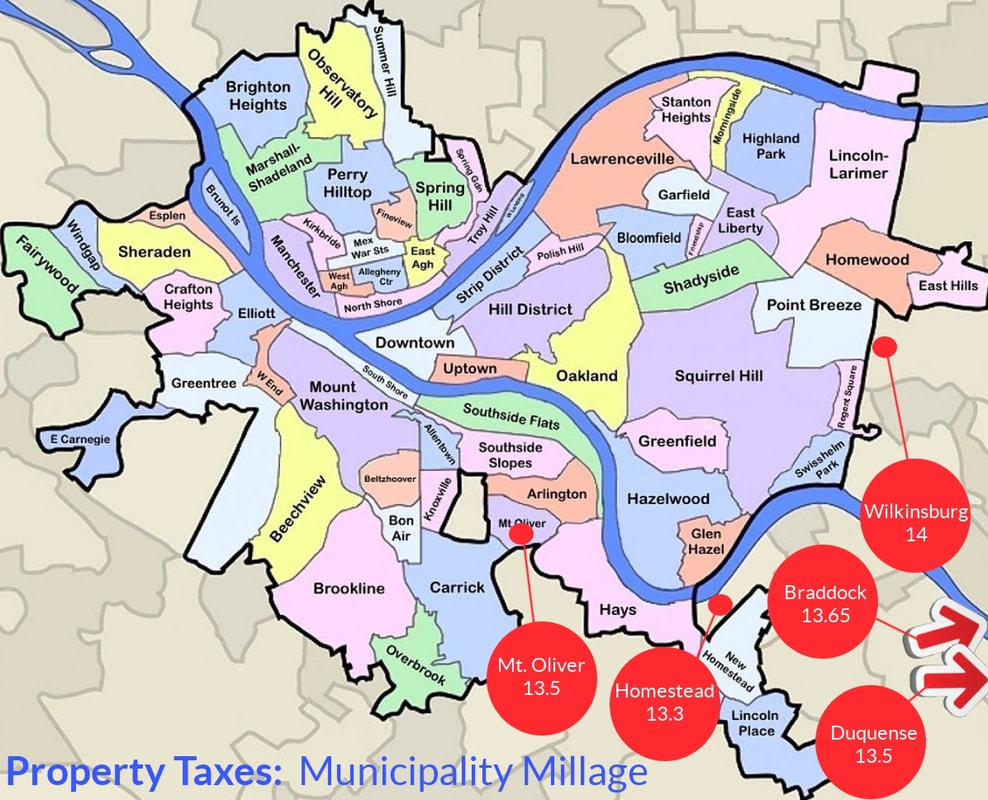
  • Municipal property tax millage
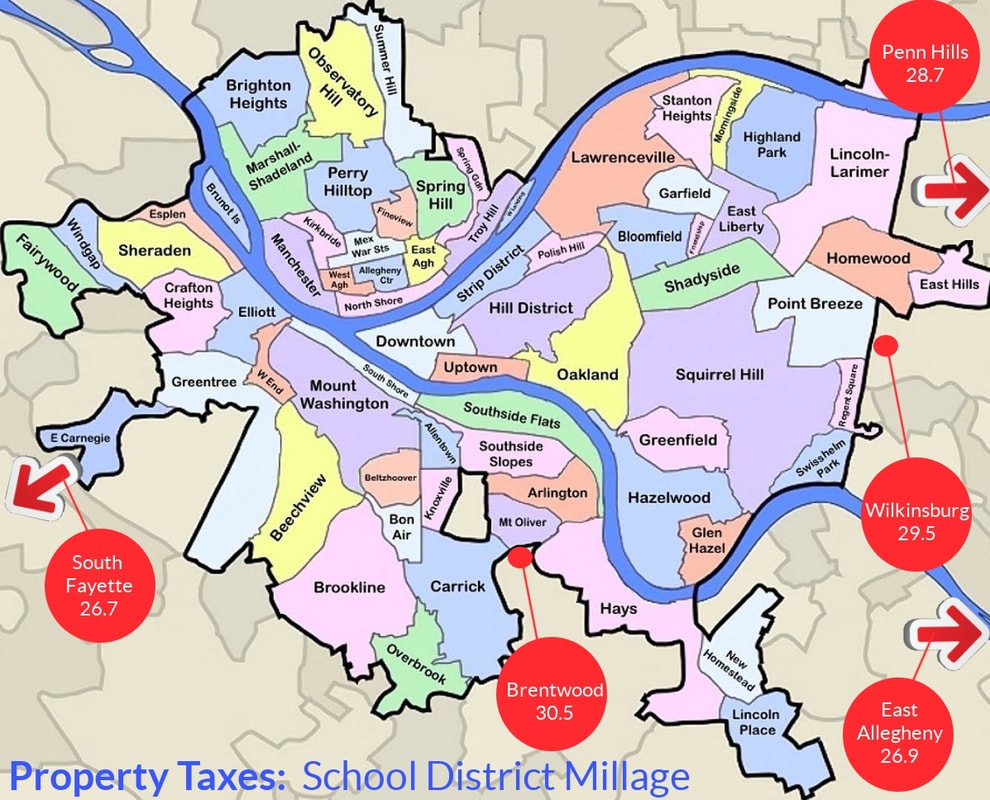
  • School district millage
  • Local earned income tax rates and PSD codes
  • Real estate transfer tax rates
  • Which services and school boundaries apply

This guide does not rank neighborhoods by tax burden. Use the property’s municipality and school district on the county portal, then apply the correct millage—not Pittsburgh defaults if the home is outside the city.

Quick tax checklist before moving or buying

  • Look up the property’s assessed value.
  • Confirm municipality and school district.
  • Confirm County, City, school, parks, and library millage where applicable.
  • Ask whether Homestead/Farmstead status is on file.
  • Understand local earned income tax based on where you live and work.
  • Budget for transfer tax if you are buying.
  • Check short-stay taxes if booking less than 30 days.
  • Verify everything with official sources or a qualified tax professional.

Pittsburgh tax questions

What is the sales tax in Pittsburgh?

The general sales tax rate in Pittsburgh and Allegheny County is 7%, made up of Pennsylvania’s 6% sales tax plus Allegheny County’s 1% local tax.

Does Pittsburgh tax income?

Yes. Pittsburgh residents generally pay local earned income tax in addition to Pennsylvania’s state income tax. The Pittsburgh resident earned income tax is generally 3%, made up of 1% City tax and 2% School District tax.

How are Pittsburgh property taxes calculated?

Pittsburgh property taxes are generally calculated by multiplying the taxable assessed value by each applicable millage rate and dividing by 1,000. Pittsburgh property owners may see County, City, Parks, Library, and School taxes.

Is property tax based on purchase price?

Not directly. Property tax is based on assessed value. Purchase price can matter in certain assessment or appeal situations, but the tax bill is calculated from the assessed value used by the taxing bodies.

Where can I find my assessed value?

Use the Allegheny County Real Estate Portal to look up the property and find its assessed value.

What is a mill?

One mill equals $1 of tax for every $1,000 of taxable assessed value.

What is Pittsburgh’s real estate transfer tax?

Pittsburgh real estate transfers commonly involve a combined 5% transfer tax: 1% Pennsylvania state tax, 3% City of Pittsburgh tax, and 1% Pittsburgh School District tax. Responsibility for payment depends on the contract and any applicable exemptions.

Are groceries and clothing taxed in Pittsburgh?

Pennsylvania exempts many everyday items from sales tax, including food that is not ready-to-eat and most clothing. Prepared food and many retail goods are generally taxable.

Official sources and helpful links

Use these official resources to verify rates, exemptions, and forms. doSh publishes this guide for education—not as a substitute for professional advice.

City of Pittsburgh Property Tax Worksheetpittsburghpa.gov City of Pittsburgh 2026 property worksheet2026 calculator HTML Allegheny County Treasurer millage ratesCounty & school millage Allegheny County Real Estate PortalLook up assessed value Homestead / Farmstead Exclusion (Act 50)Allegheny County Allegheny County Realty Transfer TaxesTransfer tax overview PA Personal Income Taxpa.gov / Revenue PA Sales, Use, and Hotel Occupancy Taxpa.gov / Revenue City of Pittsburgh TaxesCity tax hub PA Common Level RatioAppeals & transfer contexts

Moving to Pittsburgh and still figuring out where to live?

If you are relocating, comparing neighborhoods, or waiting to buy, a furnished doSh home can give you time to settle in before a permanent decision.

View Furnished Homes Relocation Housing Contact doSh

412-612-3522 · [email protected]

Furnished Housing Solutions

Corporate Housing
Executive Housing
Healthcare Housing
Mid-Term Rentals
Luxury Homes
Athlete Housing
Renovation Housing

Support

Contact
FAQ
Reviews

Info

Shadyside Info
Things to do
Blog

Relocating to Pittsburgh

​The Schools
The Traffic
The Crime
The Weather
The Amenities
The Taxes
© COPYRIGHT 2015. ALL RIGHTS RESERVED.