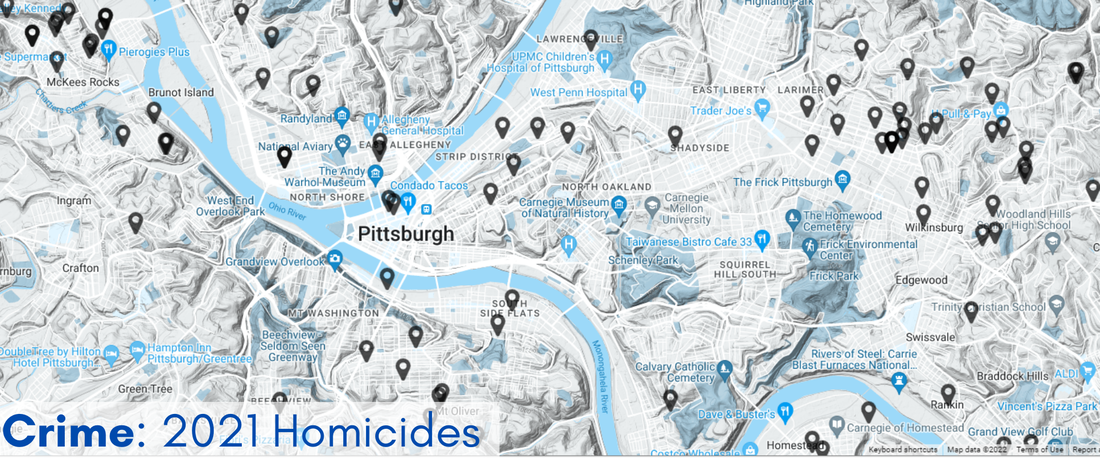
Start with Pittsburgh’s Police Data Portal, CrimeMapping, and linked city dashboards.
Pittsburgh Crime Explained: Safety Data, Crime Maps & How to Research Neighborhoods
A plain-English guide for residents, renters, homebuyers, visitors, and people relocating to Pittsburgh.
Public crime data is most useful when you match it to your address, daily routine, and comfort level—not a citywide headline. Many families and professionals relocate to Pittsburgh successfully by researching the specific places they will actually live, work, and park.
This guide is for general education and relocation planning only. Crime data can be incomplete, delayed, reclassified, or reported differently across sources. Use official tools and your own judgment before making housing decisions.
Pittsburgh crime data at a glance
Pittsburgh is a walkable, neighborhood-based city where block-by-block context matters. Instead of asking whether an entire area is “good” or “bad,” use official data to understand reported incidents near your address, parking, commute, and the times you will actually be there.
Violent crime, property crime, vehicle-related incidents, and calls for service tell different stories for housing decisions.
Neighborhood names, police zones, ZIP codes, and school districts do not always align. Check the exact property and nearby blocks.
Commute hours, evenings out, and late-night parking can feel different from a daytime map snapshot.
Dashboards show reported incidents—not every event. Records can be updated or reclassified later.
Visit or research at the times you will actually be there. Compare routes to work, school, transit, and daily errands.
This page does not rank neighborhoods, assign scores, or steer you toward or away from any area. It explains how to research reported incidents using official tools and your personal comfort level.
Relocating with a clear plan
Thousands of households move to Pittsburgh each year for work, healthcare, education, and family life. A practical approach is to verify public data for your specific address, walk or drive your real routes, and—if you are not ready to buy or sign a long lease—use a furnished extended stay to experience daily life before committing.
doSh furnished homes are designed for that middle phase: settle in, test commutes and routines, and make housing decisions on your timeline—not from a single crime map pin.
We do not label neighborhoods or guarantee outcomes. We help guests use objective sources, ask good questions about parking and building access, and choose housing that fits their household’s routine.
How to read Pittsburgh crime data
Start with the exact address
Neighborhood labels and ZIP codes are starting points—not substitutes for block-level research.
Use official Pittsburgh tools
Open the Police Data Portal and CrimeMapping for reported incidents near that address.
Separate violent and property crime
They answer different questions. Do not merge unrelated categories into one impression.
Look at patterns over time
One recent incident is not a trend. Compare multiple months or years when sources allow.
Compare more than one source
City dashboards, WPRDC datasets, and state UCR data may differ in definitions and timing.
Evaluate your real routine
Check parking, walking routes, transit, and building access for the hours you will actually be there.
Decide on your comfort level
Use official information plus visits or virtual scouting—each household’s routine is different.
Not all crime data means the same thing
Violent crime
Offenses involving force or threat of force (definitions vary by source)—often tracked separately on city dashboards.
Property crime
Theft, burglary, vehicle-related theft, vandalism—often most relevant for parking and housing access.
Theft from vehicles
Common in dense or street-parking areas; check near your parking route, not only your home block.
Burglary
Often more relevant to housing than general theft totals on a busy commercial corridor.
Calls for service
A call does not always equal a confirmed crime but can show activity patterns in an area.
Arrests
Reflects enforcement and reporting practices—not the same as incident occurrence counts.
Different dashboards classify and count incidents differently. Read each source’s disclaimers before comparing numbers.
Research the address, not just the neighborhood name
Pittsburgh blocks can differ sharply within the same neighborhood label. For any housing decision, map the exact property plus parking, walking routes, transit stops, school or work commutes, and places you will visit regularly. Police zones are useful for dashboard filters but are not the same as neighborhoods or ZIP codes—see Pittsburgh Police Zones.
Busy commercial or event areas often show more reported incidents than quiet residential side streets. Higher counts in a dense district do not automatically describe your home block.
Everyday questions that matter for families and renters
For furnished stays and relocations, guests often care as much about practical comfort as dashboard totals: parking, lighting, packages, building access, and how routes feel at the hours you use them.
Parking & vehicles
Garage vs street, lighting, and keeping valuables out of sight. Check vehicle-related incidents near your parking path.
Building access
Locks, keypads, exterior lighting, and who to contact for access or maintenance questions.
Packages & deliveries
Secure delivery options matter in dense blocks—ask how packages are handled.
Time of day
Scout at morning commute, school pickup, evening, or late-night hours you will actually use.
Your routes
Compare incident maps for your home block and commute, campus, hospital, or restaurant corridors separately.
Before you sign
Ask about event parking, street cleaning, alleys, trash pickup, and shared outdoor areas when relevant.
Remember: dashboard data shows reported incidents—not every event, and not your personal risk profile.
Quick checklist before you move
- Research the exact address and nearby blocks—not only a neighborhood name.
- Check the Pittsburgh Police Data Portal and CrimeMapping.
- Separate violent crime, property crime, and vehicle-related incidents.
- Review multiple time periods; read source disclaimers on definitions and updates.
- Walk or drive your commute, school, and daily errand routes at realistic hours.
- Ask about parking, locks, lighting, packages, and building access.
- Decide based on official data, your household routine, and personal comfort.
Official Pittsburgh crime data sources
These tools are maintained by city, county, state, and federal agencies. Dashboards are not embedded here—open the official links for current data.
Swipe horizontally on small screens to read the full table.
| Source | Best used for | What to watch for |
|---|---|---|
| Police Data Portal | Official city dashboards and documentation | Definition and update timing per dashboard |
| CrimeMapping | Map-based incident browsing by date | Map points may lack full incident context |
| WPRDC monthly dataset | Downloadable analysis | Requires careful filtering and interpretation |
| PA UCR / FBI CDE | State and national comparisons | Agency participation and methodology differ |
| Allegheny County violence dashboard | Serious violence trend context | Narrower category than all reported crime |
More official links
More Pittsburgh relocation resources
Common questions
Is Pittsburgh safe?
Pittsburgh, like any city, varies by location, time of day, and personal routine. Use official crime data for your specific address, compare crime types, and evaluate the routes and places you will actually use—rather than a single yes-or-no answer.
Where can I find Pittsburgh crime data?
Start with the Police Data Portal, CrimeMapping, WPRDC datasets, the Pennsylvania UCR dashboard, and the FBI Crime Data Explorer.
Is a crime map enough?
No. Maps are useful starting points, but you should also consider crime type, date range, time of day, location accuracy, parking, walking routes, transit, and your own routine.
Neighborhood or exact address?
Research the exact address and surrounding blocks. Neighborhood names, ZIP codes, and marketing descriptions are not precise enough for a housing decision.
What should I check for a furnished stay?
Parking, building access, lighting, package delivery, entry instructions, and commutes to work, school, hospitals, or daily needs.
Can doSh tell me which neighborhoods are safe?
No—we point guests to objective public data and explain how to research an area. Each household should decide based on official information, personal comfort, and daily routine.
Still exploring where to land in Pittsburgh?
A furnished doSh home gives your family time to test commutes, schools, and daily routines in real life—using official data on your terms—before a long-term lease or purchase.
Furnished Housing Solutions |
Support
|
Info |
Relocating to Pittsburgh |
© COPYRIGHT 2015. ALL RIGHTS RESERVED.
|